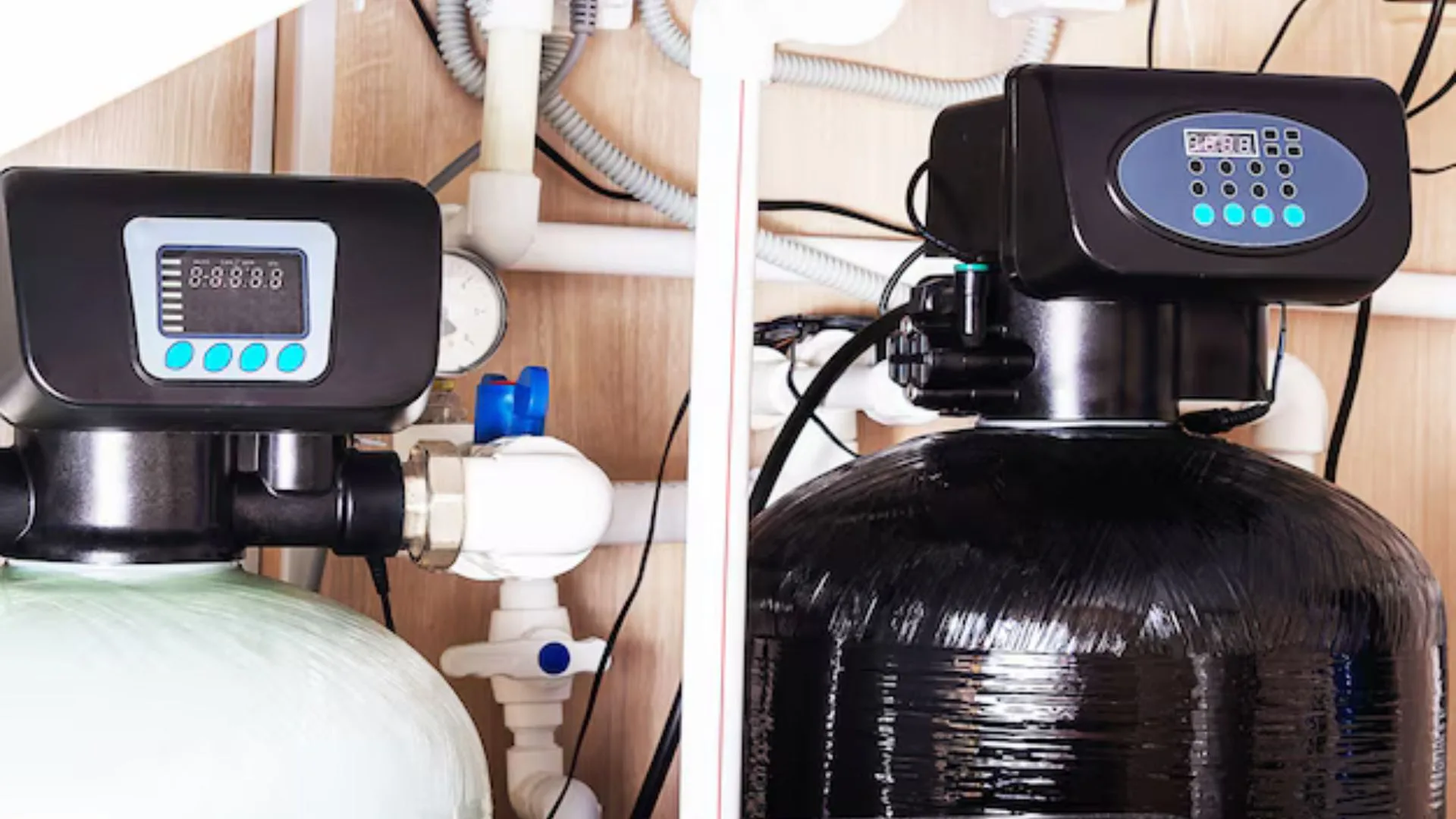
If you have been told you need a water softener in Folsom, it is worth pausing before you buy. Water softeners are a real and useful product, but they solve one specific problem, which is hard water. Whether you have that problem depends on where your water comes from. For most Folsom homes the answer is that the water is already soft. This guide explains how to check, what the numbers mean, and what to do instead if the test says you do not need one.
The City of Folsom receives all of its drinking water from Folsom Lake, according to the city's annual Consumer Confidence Report. The lake is fed by American River runoff from the Sierra Nevada, which picks up very little calcium and magnesium on the way. Those two minerals are what make water hard. The city's 2023 Water Quality Report lists total dissolved solids, a rough measure of everything dissolved in the water, at about 49 to 65 parts per million. That is a low number.
For comparison, water is generally called soft below about 60 parts per million of hardness, moderately hard from about 60 to 120, and hard above that. Total dissolved solids are not the same measurement as hardness. Hardness minerals are only a slice of what is dissolved, though, so a total this low points firmly to soft water. In plain terms, Folsom city water behaves more like rainwater than like the hard well water found in many other regions.
That does not mean you will never see spots or crust. White marks on glassware or a film on a showerhead can come from rinse aid settings, a water heater run too hot, soap residue, or a fixture that is simply old. Spots are a clue worth investigating, but they are not proof of hard water on their own. A quick test tells you far more than a look at the shower door.
Testing is cheap and fast. Hardness test strips cost a few dollars at a hardware store, and we can take a reading during any service visit. If you want a detailed report, a certified lab test is the next step. A reading under about 60 ppm means a softener would change very little in your house. A reading well above that, say over 120, is the point where softening starts to pay off.
The picture can change in a few situations. A home on a private well can have much harder water than city water, and so can a property served by a different supplier than the City of Folsom. If you live outside the Folsom water system, or you are on a well, test first rather than assuming either way. We would rather give you a real number than a sales pitch.
Many people asking about softeners are really asking about taste. A chlorine smell, a flat taste, or cloudiness in a glass of water are filtration questions, not hardness questions. A carbon filter at the kitchen sink or on the main line reduces taste and odor, and a reverse osmosis system under the sink gives the cleanest drinking water. Neither one softens water, and neither needs a salt tank.
Soft water also changes how you think about appliances. Scale builds slowly in soft water, so a tank water heater is more likely to fail from corrosion and sediment than from heavy mineral crust. We still recommend checking the anode rod and flushing a tank unit now and then. Tankless units still benefit from periodic flushing, because manufacturers write their schedules for a wide range of water, but the interval is less urgent where the water is soft.
There is a money side to this decision. A whole-house softener is a meaningful upfront cost, plus salt and some water used for regeneration. If your water is already soft, that spending buys you almost nothing, and the savings people expect on soap and appliance life never show up. The same money spent on a good drinking-water filter usually gives a more noticeable improvement.
When a softener is warranted, the installation matters. Size it to the household and the measured hardness rather than a generic unit, add a bypass valve so outdoor taps and irrigation do not use up softened water, and plan for a salt supply and periodic maintenance. We install to California Plumbing Code (UPC-based) standards, and we test before and after so you can see the difference in numbers.
Our approach is simple. We test, we show you the number, and we recommend treatment only if the number supports it. If the answer is that you need nothing, we will tell you that and move on. If you do need something, we will explain exactly what the system is solving, so you are never paying for a problem you do not have. If you would like a real number for your own tap, call us and we will test it during a visit, with no obligation to buy anything afterward.
What to do before buying a water softener
- Run a hardness test, with strips or a lab report, before you shop
- Find out whether you are on city water or a private well
- Compare your reading to the soft range, roughly under 60 ppm
- Decide whether your real complaint is taste or odor, which is filtration
- Have any system sized to the measured hardness and your household
What the City of Folsom says about its water
The City of Folsom's pinhole leaks page describes the City's water as having low alkalinity and buffering capacity. The City adds orthophosphate to help protect the inside of pipes, and it notes that activated carbon whole-house filters can reduce phosphate by 70 to 90 percent.
If you are considering a whole-house filter, the City suggests checking with the manufacturer first. For questions about your drinking water, the City's Environmental and Water Resources Department is at 916-461-6177.
We also serve nearby El Dorado Hills and Fair Oaks, so help is close if you are in one of those areas.
A local question
Will a whole-house carbon filter affect the pipe protection in Folsom's water?
The City of Folsom says activated carbon systems can reduce phosphate by 70 to 90 percent, which could reduce the effectiveness of the orthophosphate the City adds to protect pipe interiors. It suggests checking with the manufacturer before installing a whole-house filter.